Start a conversation
Home About us Solutions ESG · Circular Economy Strategic Partnerships Case studies Start a conversation
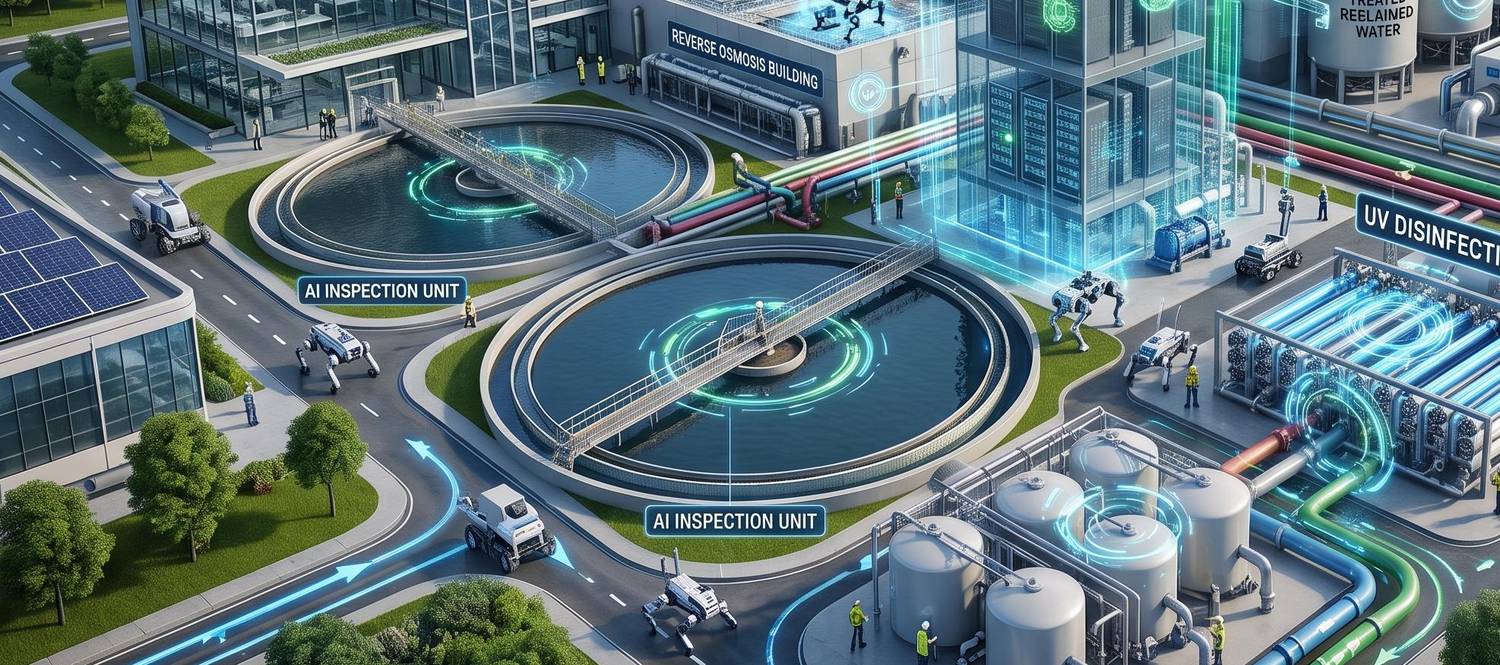
Water reclamation plant with AI-assisted monitoring
Strategic partnerships

Technology we bring in.

Every plant we build uses the best available process. Sometimes the best available process is not ours, and pretending otherwise would cost the client the better plant.

Modular plant Autonomous operation Local delivery and support In-country engineering
Technology partners

Where conventional treatment runs out of road

Some duties cannot be solved with a bigger RO train. We hold partnerships that give our clients access to technology developed outside Malaysia — delivered, installed and supported by an engineering team on the ground here. As always, Darcarion’s scope goes well beyond the equipment.

BlueNexus Technologies

The technology arm of GreenTech, building modular, AI-operated water plants for industrial and municipal use — i-WaterHub™ and the AquaX Robot™ operating layer.

The plant is one part. Darcarion covers the rest. Site survey and water characterisation come first, then the civil and structural works, the utilities tie-in, and any additional process or polishing stages a specification demands above the standard configuration. Project management, authority submissions and documentation are ours, so delivery stays on one schedule and one point of contact. And it does not end at handover — commissioning support, operator training, spares and chemicals, and long-term operation and maintenance all sit with the same team.

bluenexus.tech ↗

i-WaterHub™ A plant that arrives finished

A conventional plant is a construction project — civil works first, equipment after, commissioning last, and every problem found on site. This inverts that. Equipment, controls, pipework, structure and buildings are integrated into 40-foot modular units, built on a factory assembly line, then commissioned and trial-operated before they ship. On site the work reduces to assembly and connection.

Delivery is measured in weeks rather than the seasons a conventional build takes — which changes what is possible when a project is waiting on water. BlueNexus reports up to 90% less footprint than a conventional equivalent.

SeriesSource waterProcessCapacityFootprint
UFSurface waterUltrafiltration3,500 – 10,500 m³/d146 – 239 m²
URWWTP effluent, surface waterUF and reverse osmosis2,500 – 10,000 m³/d192 – 568 m²
BWBrackish waterBrackish reverse osmosis2,500 – 10,000 m³/d192 – 568 m²
SWSeawaterSingle or dual stage desalination2,500 – 5,000 m³/d285 – 565 m²
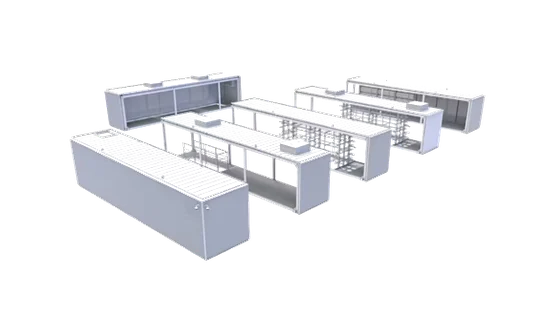
Modular units shown in exploded view
Modular units
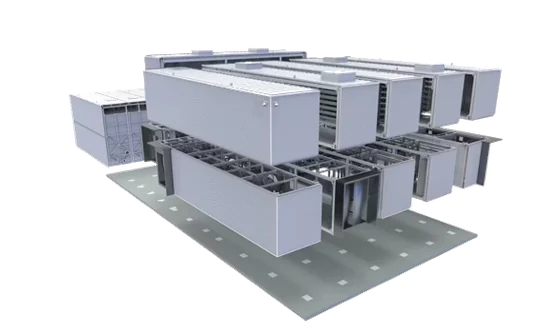
Modules arranged as a complete plant
Assembled plant
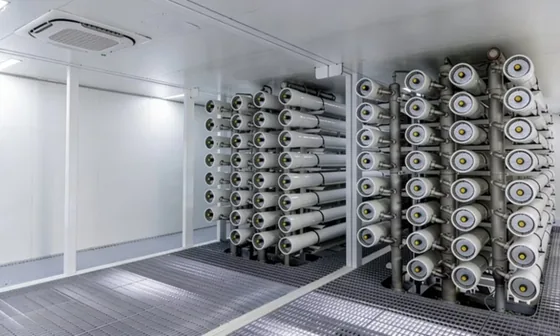
Reverse osmosis membrane racks inside a module
Inside a module
40-foot modulesFactory commissionedIndustrial and municipalRelocatable

AquaX Robot™ An operator, not a dashboard

AquaX Robot runs the plant rather than reporting on it — analysing, deciding and executing, instead of raising alarms for somebody else to action. Computer vision, acoustic and infrared sensing give it real-time awareness of plant condition, working alongside process optimisation models and predictive maintenance on both equipment and process. Relevant anywhere certified operators are hard to find and harder to keep.

At the partner's own service centre, a distributed unmanned operating model let ten staff run the operation. BlueNexus reports reductions of 90% in labour, 50% in equipment failure rate, 30% in electricity, 15% in chemical cost and 35% in overall operating cost.
Autonomous operationPredictive maintenanceProcess optimisationRemote support

SideStroem

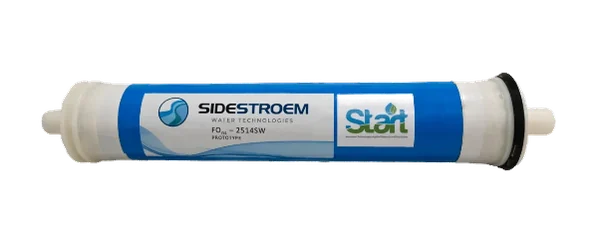
Developer of nano-selective forward osmosis — a membrane process that moves selected species out of a stream without the pressure and energy a conventional train needs.

This is early technology, piloted in one industry to date and not yet installed at scale in this region. We hold the partnership because we think the applications here are real, and we are looking for the operators willing to prove it.

Forward osmosis membrane element
Forward osmosis element · prototype
sidestroem.com ↗

Recovering the salt instead of burning it off Zero liquid discharge

ZLD works, but the economics are brutal: the tertiary stage is energy-hungry, the footprint is large, and the brine it returns is often too poor in quality to reuse. Forward osmosis attacks each stage — reducing load ahead of primary treatment so existing capacity goes further, producing recycled brine clean enough to put back into the process, and removing the need for costly tertiary equipment. SideStroem reports up to 55% OPEX and 50% CAPEX savings on greenfield systems.

Where salt is a process input rather than a nuisance, recovering it changes the arithmetic again — in textile production, where the technology was first piloted, roughly a kilogram of salt is consumed for every kilogram of product. Across South and Southeast Asia, industrial reuse still sits below 8%.

ZLD retrofitGreenfield ZLDSalt recoveryBrine quality

Taking the brake off a fermenter Industrial fermentation

Batch fermentation stalls on its own byproducts. Ethanol begins inhibiting cell growth at concentrations near 2%, substrate goes unconsumed into the effluent, and low product titre leaves you paying twice — once in energy to concentrate the product, again in volume to treat the wastewater. Forward osmosis gently draws inhibitory byproducts out of the broth while fermentation continues, which is what makes continuous operation possible.

SideStroem reports up to a twentyfold productivity increase, OPEX savings up to 80% and CAPEX savings up to 50%.

Continuous fermentationInhibitor extractionSubstrate utilisation

Concentrating without heat Food and beverage

Food and beverage streams carry value that evaporation destroys — heat degrades flavour, colour and heat-sensitive compounds, and it is expensive to apply. A gentle, low-pressure concentration step opens a different route for process streams and side streams currently treated as effluent.

This is a possible application rather than a proven one. SideStroem's work to date has been elsewhere, and we have not yet run it on a food stream. We raise it because the fit looks credible and the local industry is large — and because the only way to find out is to try it on a real stream. If you operate one, we would like to talk.

Gentle concentrationSide-stream valorisationHeat-sensitive products

Tell us what you need to treat

Send us the source, the target specification and the flow. Our engineers will come back with an approach — and a treatability test if the chemistry warrants one.